

Individuals with little or no technical background can now build software using AI-powered tools.
This shift has led some industry observers to ask a provocative question: could AI signal the end of the SaaS industry?
Not long ago, a highly successful technology entrepreneur predicted that all SaaS stocks could be worth zero within two years. While that may sound extreme, such concerns have already affected market sentiment.
Over the past year, software stocks on Wall Street have declined by roughly 20%, reflecting growing anxiety about AI’s potential impact on software companies.
The concern is straightforward. If AI allows companies to build their own software internally, or even replace software altogether, demand for SaaS products could decline.
Additionally, many SaaS businesses operate on a per-seat pricing model, meaning that if AI reduces the number of employees, the number of paid software seats could shrink as well.
However, the reality is far more nuanced.
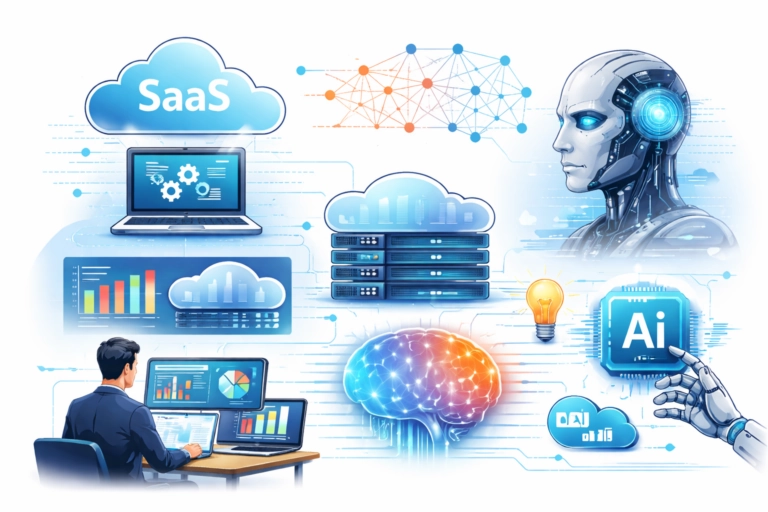
What Is SaaS?
SaaS (Software as a Service) is software that you use online instead of installing on your computer. You usually pay a subscription to access it, and the provider handles updates, maintenance, and security.
Examples include Slack for team messaging, Zoom for video calls, Salesforce for managing customers, Dropbox for file storage, and Jibble for time tracking and workforce management.
The SaaS model offers several advantages:
- Lower upfront costs compared to traditional software
- Automatic updates and maintenance handled by the provider
- Easy scalability for adding or removing users
- Accessibility from any device with an internet connection
Because of these benefits, SaaS has become the dominant model for delivering business software over the past two decades.
Who Makes SaaS?
SaaS products are typically created by software companies and startups that specialize in cloud-based solutions. They combine teams of:
- Software engineers and developers – who build the application’s core functionality
- UX/UI designers – who ensure the software is easy to use
- Product managers – who define features based on user needs
- Data and AI specialists – who add intelligence, automation, and analytics
- Operations and support teams – who maintain the service, handle security, and assist users
Some SaaS tools are also developed by internal IT teams within larger companies for their own business needs, though most widely used SaaS platforms come from dedicated software providers.
Image by Pexels from Pixabay
AI Makes Software Easier to Build (For Everyone)
There is no doubt that AI is dramatically lowering the barrier to building software.
Modern AI coding tools can accelerate development, automate repetitive tasks, and even generate large portions of application logic. As a result, new startups can build products faster and at significantly lower cost than was possible just a few years ago.
But an important point is often overlooked: the same AI tools are available to established SaaS companies.
Incumbent software firms are not standing still. They are adopting AI to improve their products, streamline development, and deliver new features faster than ever before.
History provides useful perspective. Over the past three decades, software has consistently become easier to build as programming tools and infrastructure improved. Yet during the same period, software prices and SaaS revenues have continued to rise.
The reason is simple: software companies create value that extends far beyond code.
SaaS Companies Are More Than Just Software
A successful SaaS business is not defined solely by its product.
Its competitive advantage often lies in a broader ecosystem that includes:
- Brand recognition and market trust
- Sales and distribution channels
- Customer support infrastructure
- Integrations with other platforms
- Partner networks
- Existing user communities
- Large datasets and usage insights
These elements are extremely difficult to replicate quickly.
Even if a competitor manages to build a technically similar product using AI, selling it at scale is a completely different challenge.

Photo by Jayanth Muppaneni on Unsplash
A Lesson From the Cola Wars
Technology is not the only industry where superior products failed to win the market.
Consider the example of Virgin Cola in the 1990s. Blind taste tests reportedly showed that many consumers preferred its flavor over Coca-Cola. Yet despite this advantage, Virgin Cola eventually disappeared from shelves.
Why? Because Coca-Cola’s real strength was never just its formula—it was its distribution network, brand equity, and global ecosystem.
The same principle applies to SaaS companies. Code may become easier to replicate, but market position is far harder to copy.

Image by Habitat_de_lill from Pixabay
The Power of Ecosystems and Network Effects
For established software companies, growth often comes from accumulated momentum.
At Jibble, nearly 100,000 new users sign up every month, and they does so based on:
- Thousands of verified user reviews
- Strong search engine rankings
- Visibility in AI-driven search results
- Word-of-mouth recommendations
- A well-developed partner ecosystem
Building this level of credibility and distribution can take years of sustained effort; advantages as such, would take years for any new competitor to replicate.
Even if someone builds a similar product at 1/10th the cost using AI, incumbents like Jibble can use the same AI tools to innovate faster. Code is becoming a commodity; but the value in SaaS is the ecosystem, not the software itself.
Code Is Becoming a Commodity, But That’s Not Where the Value Lies
AI is undeniably commoditizing certain aspects of software development. Writing code is becoming faster and more automated.
However, code has rarely been the true source of long-term value for successful software companies.
Instead, the most valuable assets tend to be:
- Brand reputation
- Customer relationships
- Product reliability
- Integration networks
- Data and insights
- Market positioning
In this sense, the value of a SaaS company resembles that of a global consumer brand: the formula matters, but the ecosystem matters far more.
Why Most Businesses Won’t Replace SaaS With AI
Another assumption driving fears about SaaS is that companies will replace external software with internally built AI tools.
In practice, this scenario is unlikely for most organizations.
Even technology companies with strong engineering teams continue to rely on best-in-class software products rather than building every tool internally. The reason is straightforward: software costs are usually small relative to the operational value they provide.
Businesses typically prioritize reliability, support, security, and scalability; qualities that established SaaS providers already deliver.
As a result, replacing proven tools with internally built alternatives rarely becomes a priority.
The Job Loss Narrative Is Also Overstated
Some analysts argue that AI-driven automation will drastically reduce employment, which in turn could reduce SaaS seat-based revenue.
This concern echoes fears that appeared during the Industrial Revolution, when machines dramatically increased production efficiency.
Yet history shows that technological progress tends to shift jobs rather than eliminate them entirely. New industries, roles, and opportunities usually emerge alongside productivity gains.
Even in a highly automated economy, businesses will still need tools to manage operations, productivity, collaboration, and data.
In other words, software demand is unlikely to disappear.
SaaS Revenues Remain Strong
Despite the pessimism in financial markets, the underlying performance of SaaS companies remains robust.
While stock prices may fluctuate with investor sentiment, many software companies continue to report strong revenue growth and expanding user bases.
The disconnect between market fears and real-world demand suggests that the SaaS industry is evolving—not collapsing.

Image by Frank Rietsch from Pixabay
AI Will Create More Competition, But Also More Opportunity
There is no question that AI will make it easier to launch new software startups. This will inevitably increase competition across many categories.
However, increased competition cuts both ways.
New entrants may find it easier to build products, but they will also face a crowded market with many other AI-enabled startups attempting the same strategy.
Standing out in such an environment will be more difficult than ever.
Ironically, this dynamic may strengthen the position of established SaaS companies with large user bases, strong brands, and mature ecosystems.
The Real Opportunity: AI-Native SaaS
Rather than replacing SaaS, AI is likely to become a core layer of modern software platforms.
The companies that benefit most will be those that integrate AI deeply into their products and development processes.
Key advantages include:
- Faster product iteration cycles
- Improved automation and insights for users
- More personalized user experiences
- Greater operational efficiency
In this sense, AI should be viewed less as a threat to SaaS and more as a powerful accelerator for the next generation of software companies.
Why SaaS Will Endure in an AI World
AI is transforming software development and lowering barriers to entry across the technology industry.
But the idea that AI will eliminate SaaS misunderstands where the real value of software companies lies.
The strongest SaaS companies are not defined solely by their code. They are defined by their ecosystems, distribution, brand trust, and loyal user bases.
AI will certainly reshape the industry, increase competition, and change how software is built.
Yet for established SaaS companies that embrace AI as a foundational layer of their technology stack, the future may be more promising than ever.
FAQs
Some frequently asked questions...
What does SaaS stand for?
SaaS stands for Software as a Service.
It refers to software that is delivered over the internet rather than installed on a local computer.
Users typically pay a subscription to access the software, and the provider manages updates, maintenance, and security.
What’s the difference between SaaS and regular software?
Traditional software is installed on your device and updated manually.
SaaS runs in the cloud and is accessed through a browser or app, with updates, maintenance, and security handled by the provider.
Is SaaS safe to use?
Yes, most SaaS providers use strong security measures like encryption, passwords, and backups to protect your data.
Always check where your data is stored and what security steps the company takes.
Can SaaS work offline?
Most SaaS products require an internet connection because they run in the cloud.
Some tools offer limited offline features, and Jibble, for example, has an offline mode that lets employees track time even without internet access, syncing automatically once a connection is restored.
What is Jibble and how does it work?
Jibble is a cloud-based time tracking and workforce management SaaS platform.
It helps businesses track employee hours, manage attendance, and generate reports.
Employees can log time using web, mobile, or biometric devices, and managers can use the dashboard to monitor productivity and compliance.