

This Review Covers:
- Overview
- What Do Users Like About Toggl?
- What Don’t Users Like About Toggl?
- What Pricing Plans Does Toggl Offer?
- What are the Standout Features of Toggl?
- Selected Positive User Feedback
- Selected Negative User Feedback
- What are Toggl’s Ratings from Review Sites?
- What’s My Final Verdict on Toggl?
Overview
Functioning mainly as a time tracker, Toggl (previously Toggl Track) is intended for individuals and teams who want to know where their work hours go. It’s fairly easy to use and has a well-designed interface, although some features may take a bit of a learning curve.
You can use the app to track time on your desktop, browser, mobile — even on your smartwatch! Great if you’re always on the move or working across different locations.
Aside from being a reliable time tracker, Toggl also has some pretty useful organizing, task management, planning, and reporting features.
I like how you can organize time data under categories like projects, tasks, clients, tags, and more. Once you create projects and tasks, you can easily assign them to team members and set custom billable rates.
Toggl also does particularly well when it comes to reporting. You can generate different report types complete with filters and visual charts, so you have a clear view of time utilization and productivity. These reports can be exported as Excel, PDF, or CSV files, making it easy to share and analyze the data.
With over 100+ integrations, I’d say Toggl is on track in its mission to simplify time tracking across multiple platforms.
But I’ll be very honest with you: there are some areas where Toggl falls off track. Users have had issues syncing between the mobile and desktop app. Some have even lost their time data because of it.
The price tag that comes with Toggl’s paid plans is also easily more expensive compared to other options in the market, with similar, if not more powerful, features.
For $9/user/month billed annually on their Starter Plan, users might expect additional advanced features such as GPS tracking, facial recognition, or screen monitoring — tools that could enhance the app’s functionality and security. But no, Toggl maintains its focus on simplicity, offering straightforward time tracking, which could be a good or bad thing, depending on your needs.
So is Toggl worth it? Well, let’s take a little closer look at its features and what else users have to say to find out.
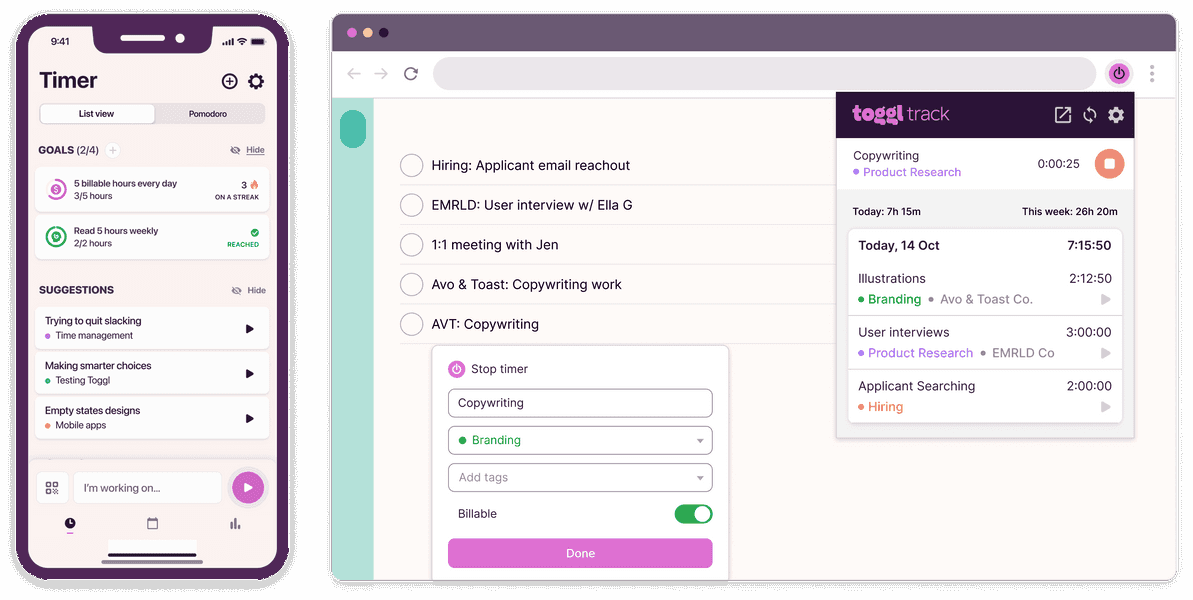
Photo from Toggl
What Do Users Like About Toggl?
- Reports and analytics customization
- 100+ integrations with other apps
- Friendly and pleasant user interface
Find more on what users love about Toggl.
What Don't Users Like About Toggl?
- Bugs causing difficulty logging in
- Mobile app has syncing issues
- Relatively expensive
- Interface can take time to learn
Find more on what users hate about Toggl.
What Pricing Plans Does Toggl Offer?
Toggl has four pricing plans, each coming with distinct features, scaling up in quantity and quality with each tier:
- Free
- Starter
- Premium
- Enterprise
Paid plans begin at US$9/mo/user when billed annually. There’s also a 30-day free trial for their Starter and Premium plans and a 30-minute demo that can be booked for their Enterprise plan.
Photo from Toggl
Toggl’s free plan is fairly generous. For light time tracking and simple project planning, I’d say it’s adequate for solo workers or small teams.
Their paid plans, however, are more on the expensive side. Having evaluated most of the time tracking software on the market, I can confidently say there are alternatives that offer similar, if not more powerful, features at a lower price point.
A 5-person team on Toggl’s Starter plan would be paying $45/month when billed annually. With a competitor like Jibble, this wouldn’t cost a penny.
Jibble offers features like time tracking, timesheets, attendance verification, powerful integrations, and more, all free for an unlimited number of users. That’s a lot of value, without the hefty price tag!
It all really boils down to your team’s specific needs and the features that are essential for your workflow.
Read more about the 5 things you MUST know about Toggl’s pricing.
Want a better alternative to Toggl? Jibble is the best Toggl alternative.
What are the Standout Features of Toggl?
1. Reporting
Toggl’s reporting feature offers businesses a clearer understanding of how employees spend their time. It’s organized into five tabs:
- Summary report: Shows an overview of total hours, billable vs. non-billable time, and performance trends.
- Detailed report: Gives you all time entries in one place, useful for auditing billable hours and invoicing. Filters help you catch missing data, oddly short or long entries, and non-billable items.
- Workload report: Helps you assess team workload by showing time spent or revenue generated across members, projects, clients, tasks, and tags.
- Profitability report: Provides data for revenue, labor costs, and profit by members, projects, clients, and more, to help businesses make better staffing and project budgeting decisions.
- My Reports: Saved and custom reports to visualize specific data points and share them with teammates and stakeholders.
Toggl offers multiple filters with conditional and AND/OR logic, allowing you to analyze data without time-consuming exports. However, if you need it, reports can be exported as PDFs for free, with Excel and CSV exports available on paid plans.
Photo from Toggl
2. Multi-Device Compatibility
You can use Toggl on almost any Internet-connected device, including PCs, mobile phones, and smartwatches. Toggl also has browser extensions for Chrome, Edge, and Firefox.
The app doesn’t perform on all platforms equally, though. While the web app offers a solid experience, the mobile app struggles with a range of issues. Some users have experienced syncing issues with the timer and frustratingly slow loading times. Others can’t even log in to the app after several attempts.
These unpredictable issues, although few, can easily disrupt workflows and undermine the convenience that a time-tracking tool is supposed to provide. For teams relying heavily on mobile access, these shortcomings could be a significant drawback.
Photo from Toggl
3. Integrations
Toggl integrates with more than 100 productivity tools such as Asana, Evernote, GitHub, Jira, Notion, Google Calendar, Salesforce, Slack, Zapier, Xero, and more.
By installing the browser extension, users can add and control the Toggl timer on supported platforms. This makes it easy to integrate Toggl into your existing workflow without much setup.
If some apps on your tech stack aren’t included in Toggl’s list of app integrations, you have the option to create custom integrations with Toggl’s REST API. This allows for greater customization, enabling you to tailor the app’s features to specific needs or build entirely new functionalities on top of the app.
Now, this is more of a complex route, and you’ll need a good amount of technical knowledge to set it up, but it’s good to have that option.
Photo from Toggl
4. Pomodoro Timer
If you’re fond of the Pomodoro technique, you’ll be pleased to know that Toggl has a built-in Pomodoro Timer. It’s a great tool to bust procrastination and help you break down your tasks into smaller, more manageable bits.
The Pomodoro timer can be used on Toggl’s browser extension, desktop app, and mobile app. Break durations can be customized, which is great.
You can set the number of minutes for focus sessions, long breaks, and short breaks. There’s also an option to enable notifications whenever the Pomodoro timer interval ends.
Photo by Toggl
Selected Positive User Feedback
- “It’s very user-friendly. By the end of the day, I hardly even remember all the work I’ve done, and Toggl really saves my life. I use the timer to log time across multiple clients and tasks, which makes it much easier to stay on top of everything.” – Gaurav G. (Source: G2)
- “Easy to use, great user experience, and extensive integration capabilities. Reporting is easy and powerful. Most time tracking and reporting features are available on the free tier, and are good enough for a freelancer.” – Verified Reviewer in Information Technology and Services (Source: GetApp)
- “The detailed, customizable reports provide invaluable insights into our productivity and project progress, helping us identify areas for improvement and celebrate our successes.” – Yugo M. (Source: G2)
- “Super easy to use and manage timekeeping across multiple different projects. Reporting is simple, and I love the reminders when I forget to turn my timer off.” – Katelyn S. (Source: Capterra)
- “It’s made time tracking really seamless and gives me brilliant data to understand how I use my time, which helps me make more robust and realistic plans.” – Matt K. (Source: Capterra)
Selected Negative User Feedback
- “not as intuitive as I wish it was, bad app both on desktop and mobile” – Haley G. (Source: Capterra)
- “failure to sync – and not knowing why – has been giving me anxiety for possibly losing data and then losing time in troubleshooting and recovering the information I need.” – Pate Ricafort (Source: Google Play Store)
- “I like the idea, but the application is so buggy it’s insane. Lagging, can’t edit most of the times. Yes they are still present after update.” – Norbert Gál (Source: Google Play Store)
- “The timer never syncs for me, so I have entries on my phone that never gets uploaded and entries on my PC that I don’t see on my phone…” – Odain Chevannes (Source: Google Play Store)
- “Often clunky to add in a new log which makes using it less attractive and easier to forget to do it.” – Ash M (Source: GetApp)
What are Toggl's Ratings from Review Sites?
As of October 2026
- Capterra: 4.7/5
- G2: 4.6/5
- TrustRadius: 9.0/10
- GetApp: 4.7/5
- Play Store: 4.5/5
- App Store: 4.8/5
What's My Final Verdict on Toggl?
Having gone through all of Toggl’s key features, I’d say Toggl is an adequate time tracking software.
The time tracking features are simple and basic, which can be good or bad depending on your needs. While it lacks advanced options like GPS tracking, facial recognition, or screen monitoring, its simplicity makes it easier for teams that don’t require complex tracking.
Toggl’s key strength truly lies in its ability to deliver the core concept of time tracking with simplicity and precision, backed by lighter planning and capacity tools that sit right next to your tracked hours.
The reporting capabilities are commendable, offering detailed views into team productivity and project profitability. Its long list of integrations ensures that it fits smoothly into existing workflows, which is a big plus for teams already using other software. And the Pomodoro timer is a thoughtful addition.
Having said all that, is Toggl worth it?
Well, feature-wise, I think it’s good for simple time tracking. Price-wise, it’s a little more expensive than what it’s worth. I can think of several other time tracking software off the bat that can offer more for much less.
I’m not discouraging you from trying out Toggl. If you’re not particularly concerned about the price, I say give it a go! It might just be the time tracking software that fits your team’s needs.
If you’re on the hunt for better and more cost-effective options, you can check out our brutally honest reviews of time tracking software. Cheers!