
US Minimum Overtime Wage
We created this US Minimum Overtime Wage Poster to show how overtime pay rates apply across all 50 states in 2026.
What Is the Minimum Overtime Wage in the US?
Under the Fair Labor Standards Act (FLSA), employees in the US earn overtime pay for hours worked beyond 40 in a single workweek.
Federal law sets overtime pay at 1.5 times an employee’s regular rate of pay. States may apply higher minimum wages, which directly affects overtime rates.
When Does Overtime Pay Apply Under Federal Law?
Overtime pay applies once an employee works more than 40 hours in a workweek.
The FLSA defines a workweek as a fixed and recurring period of 168 hours, made up of seven consecutive 24-hour periods.
Employers can choose when a workweek starts, and it does not need to match the calendar week.
Can Employers Offer Comp Time Instead of Overtime Pay?
In some cases, employers may offer compensatory time off, often called “comp time,” instead of overtime pay.
This practice follows strict federal rules and does not apply to all employees or workplaces. Employers must apply comp time correctly to stay compliant.
Do Overtime Rules Allow Averaging Hours Across Weeks?
No. Federal overtime rules do not allow employers to average hours across multiple workweeks.
Each workweek stands on its own, and overtime eligibility resets at the start of every new workweek.
How Do Overtime Rates Differ by State in 2026?
State minimum wage laws influence overtime rates, which means overtime pay can vary across the US. States with higher minimum wages also have higher minimum overtime rates.
Changes to state minimum wages in 2026 directly affect the overtime rates shown in the poster.
Scroll down to download the free poster for 2026 and view overtime rates across the US in one place.
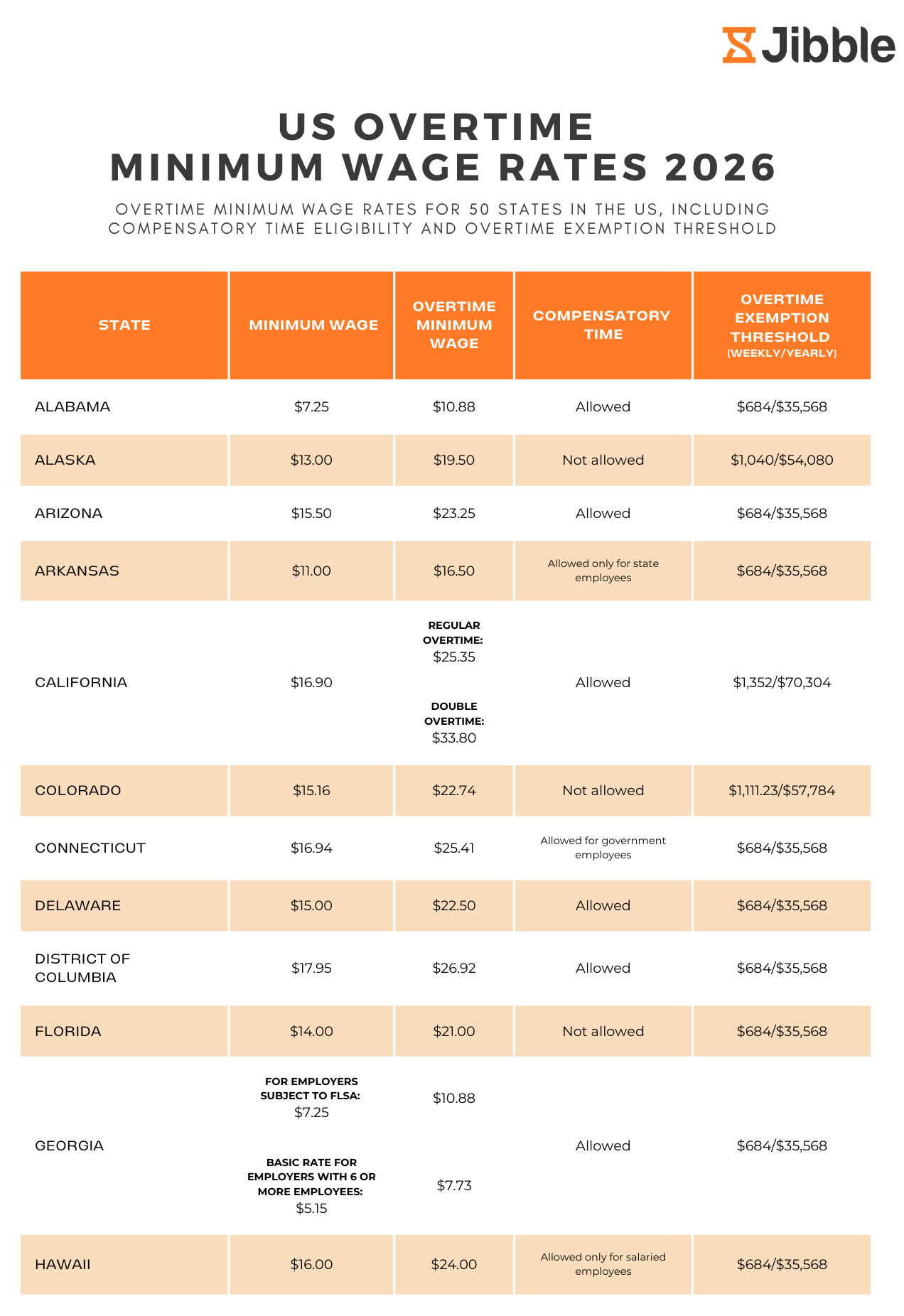
Jibble’s free poster for Overtime Rates in the US

Create an account and take the hassle out of time tracking - it's FREE forever for unlimited users!