Employee Self-Evaluation Template
Performance reviews work better when employees come prepared. A self-evaluation gives employees a clear structure to review their work, note what stood out, and flag areas that need attention before a review begins.
Teams can use a self-evaluation on its own or as part of a broader review process to bring more focus and direction into performance conversations.
What Is an Employee Self-Evaluation?
An employee self-evaluation is a structured form that employees complete to reflect on their performance over a specific period. Unlike manager-led reviews, a self-evaluation focuses on personal insight, work habits, challenges, and progress.
By capturing these reflections in advance, employees gain space to consider how their work unfolded day to day and to prepare thoughtful input for upcoming discussions.
Many teams ask employees to complete self-evaluations before formal reviews, helping set a clearer tone and direction for performance conversations.
What an Employee Self-Evaluation Covers
An employee self-evaluation template includes prompts that guide employees as they reflect on their work over a defined period, such as:
- Overall workload and focus during the review period
- Productivity highs and moments where effectiveness dropped
- Daily habits or routines that supported work or caused friction
- Common challenges, blockers, or distractions
- Personal wins or progress worth calling out
- Areas the employee wants to improve or focus on next
Instead of tracking individual tasks, these prompts highlight patterns that shape performance. When teams review self evaluations together with an employee evaluation template, discussions stay grounded in real experiences and move forward with more clarity.
How Self-Evaluations Fit Into the Review Process
Self-evaluations work best when they are used as preparation rather than a final assessment. Many teams ask employees to complete a self-evaluation before the formal review cycle begins, giving managers time to review employee input in advance.
This approach allows managers to compare employee reflections with their own observations captured in the employee evaluation process. Differences in perspective can then be discussed openly, while alignment helps reinforce shared understanding.
Used together, both forms support clearer goal setting and more focused follow-ups after the review meeting. They also help create a documented record of performance over time, without relying solely on one point of view.
Download our free employee self-evaluation template below!
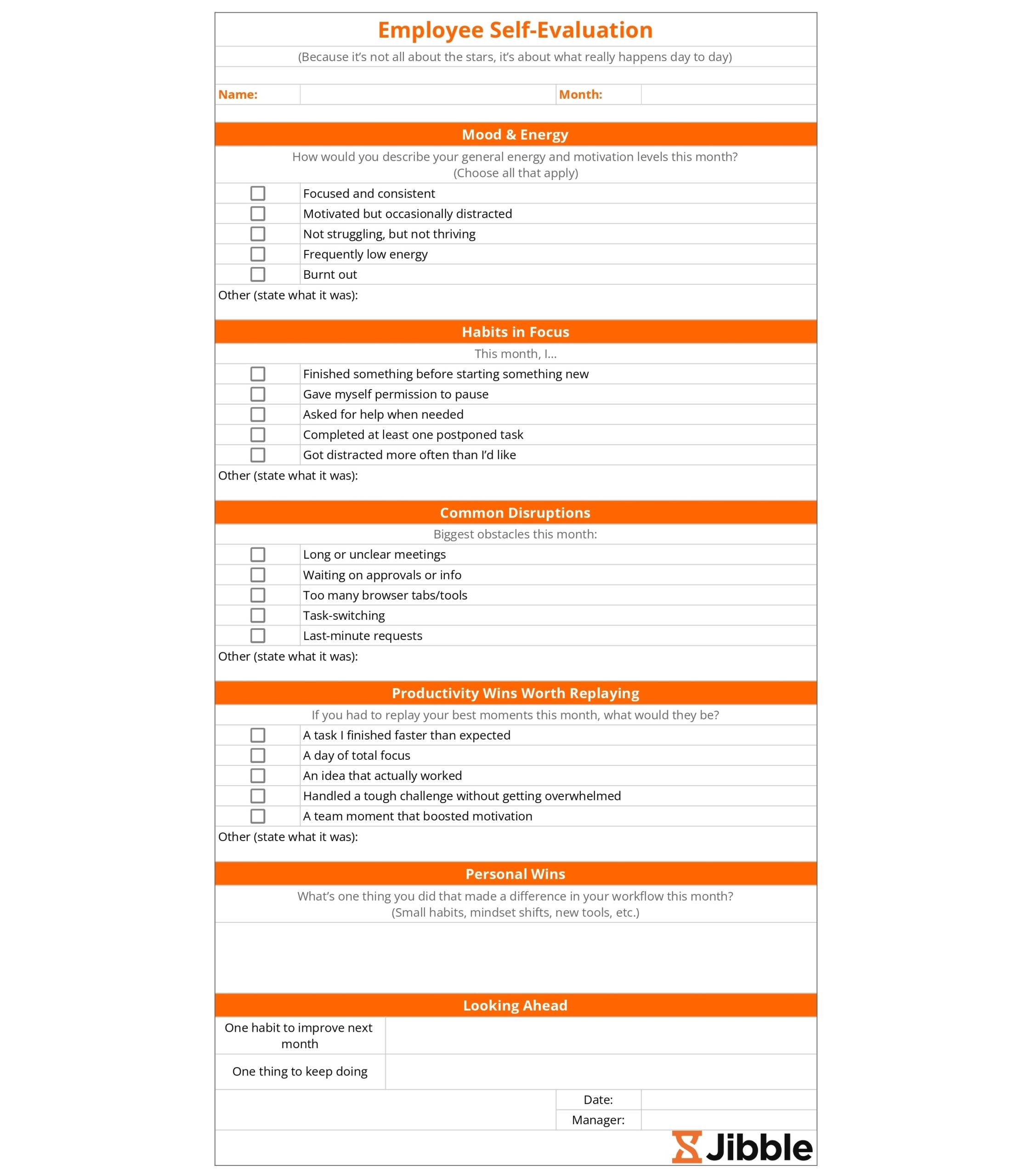
Jibble’s free employee self-evaluation template

Create an account and take the hassle out of time tracking - it's FREE forever for unlimited users!