
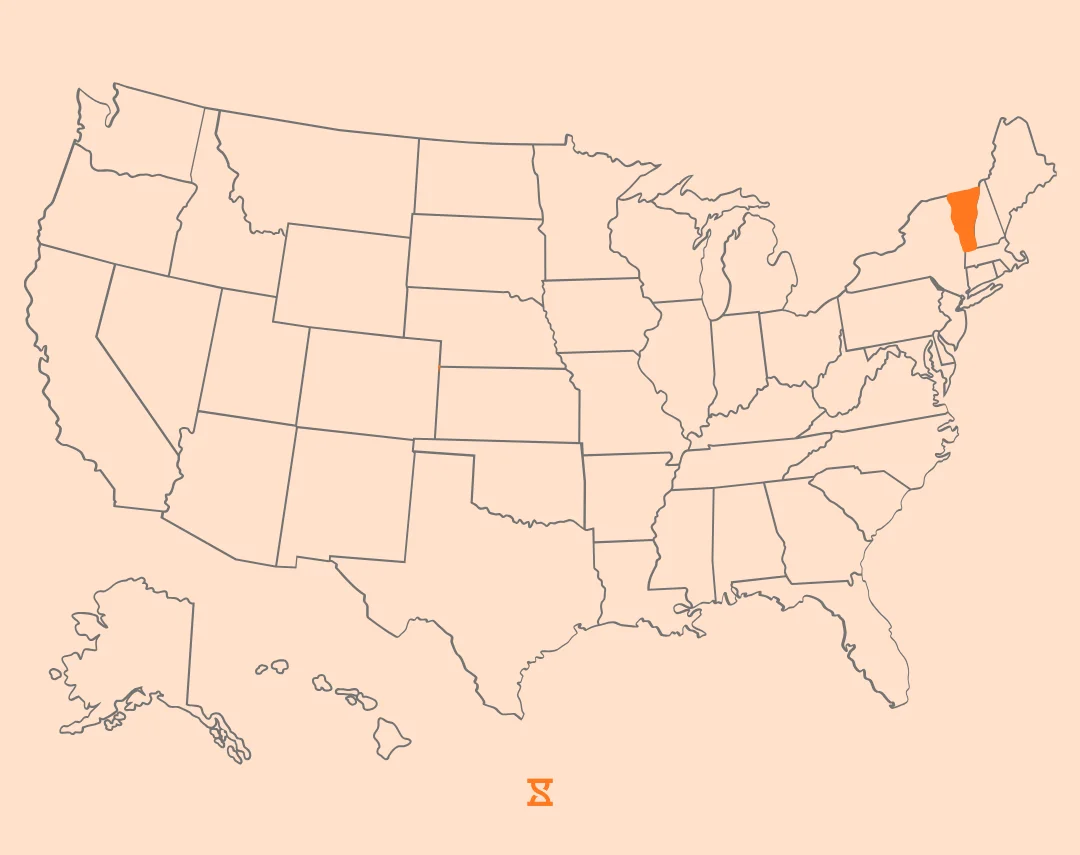
Vermont labor laws are a combination of state mandates and US federal labor laws. State laws offer stronger protections to employees as compared to federal laws, particularly for minimum wage, overtime pay, and breaks, which are briefly outlined as follows:
| Minimum Wage |
|
| Overtime Pay |
|
| Break Law |
|
This article covers:
- What are Vermont Time Management Laws?
- What are the Hiring, Working & Termination Laws in Vermont?
- Vermont Payment Laws
- What are Vermont Overtime Laws?
- Vermont Break Laws
- What are Vermont Leave Laws?
- Vermont Child Labor Laws
What are Vermont Time Management Laws?
In the US, the federal Fair Labor Standards Act (FLSA) manages the time spent by employees in the workplace, safeguarding their rights and guaranteeing fair pay for their efforts. These laws act as directives for employers, keeping them in check and minimizing any forms of abuse or exploitation.
Vermont time management laws are shaped by both state legislation and the FLSA. The state has its own minimum wage, which is higher than the federal standard.
Tipped employees in Vermont can be paid a lower cash wage; however, their cash wage and tips must equal the state minimum wage.
In Vermont, a standard workweek is 40 hours. Any hours worked beyond 40 entitle a non-exempt employee to overtime pay. Note that overtime in Vermont is only calculated on a weekly basis.
Employees in Vermont are entitled to rest and meal breaks in accordance with the FLSA. Short breaks under 20 minutes are paid, while meal breaks of 30 minutes or more can be unpaid if the employee is fully relieved of duties.
Vermont law also offers certain leave benefits to workers in the state. Employees earn paid sick leave under the Healthy Workplaces law, as well as unpaid leave under the federal FMLA. Certain employees in Vermont also receive time off on recognized state holidays.
Employees who contravene Vermont time management laws can be liable to fines, backpay, and damages. An employee who believes their employer has violated their rights can file a complaint with the Vermont Department of Labor for investigation and legal action.
What are the Hiring, Working & Termination Laws in Vermont?
Employers, employment agencies, and labor organizations in Vermont are not allowed to discriminate against job applicants during the hiring process due to certain protected characteristics as per the Vermont Fair Employment Practices Act. These include:
Similarly, employees working in Vermont are protected from employer discrimination based on the above-mentioned characteristics.
Vermont follows the at-will employment doctrine. This means that an employer can choose to fire an employee at any time, with or without reason. However, termination in violation of any public policy, such as an implied contract, is not allowed. Furthermore, if an employee’s contract does not specify the duration of employment, it is considered to be at-will.
After employee termination, all employers in Vermont are required to pay any due wages to the terminated employee within 72 hours of the designated payday. If an employee resigns, they must be paid on their regularly scheduled payday. If a regular payday is absent, then the employee must be paid by the immediate Friday.
Here are some key labor laws in Vermont that influence employement arrangements:What Are the Key Labor Laws in Vermont?
Vermont Payment Laws
What is the Minimum Wage in Vermont?
Employers with two or more employees in Vermont are required to pay their workers a minimum wage of at least $14.01 per hour.
What is a Tipped Employee’s Minimum Wage in Vermont?
A tipped employee is a service worker who regularly earns more than $120 monthly in tips, as per Vermont labor laws. These employees can be paid a minimum wage of $7.01 per hour, allowing employers to retain a tip credit of $7.00.
However, employers must ensure that a tipped employee’s cash wages and earned tips at least equal the state minimum wage. If not, the employer is required to make up the difference.
Certain types of employees in Vermont are not entitled to earn the state minimum wage as per state law. This includes:
In Vermont, every employer is required to pay their employees at least once a week. An employee’s payday must be within six days of the last day of the pay period. However, employers can choose to pay their workers semi-monthly or bi-weekly after giving a written notice to their workers. Moreover, employers are also obligated to provide a detailed statement on each payday that includes information about total hours worked, hourly rate, gross pay, and itemized deductions.
Employees who work more than 40 hours in a workweek are entitled to additional pay as per Vermont labor laws. This additional pay is calculated at 1.5 times the employee’s regular hourly wage. For minimum wage earners in Vermont, this amounts to $21.015 per hour. Note that only employers with two or more employees are covered by Vermont overtime laws. What are the Exceptions from Minimum Wage in Vermont?
When are Employee Wages Paid in Vermont?
What are Vermont Overtime Laws?
Certain employees in Vermont are not entitled to overtime pay, even if they work more than 40 hours in a week, as per state law. This includes employees working in:What are the Overtime Exemptions in Vermont?
Learn more about Vermont Salaried Employees Laws.
Vermont Break Laws
What are Vermont Break Laws?
Employees in Vermont are entitled to a reasonably timed break to eat and use the toilet under state law.
As per federal law, any lunch break lasting less than 30 minutes is paid in Vermont, provided that the break period is uninterrupted and the employee is completely relieved of all job duties.
What are Vermont Breastfeeding Laws?
Employers in Vermont are required to provide paid or unpaid breaks whenever needed by a nursing employee to express milk or breastfeed at the workplace. These breaks must be provided for up to three years after the birth of a child.
Employers are also required to accommodate nursing mothers by providing a suitable private space that is not a bathroom stall for expressing milk.
If providing breastfeeding breaks would cause significant difficulties for the business, employers can request an exemption. However, if an employee exercises their rights under the breastfeeding law, the employer is prohibited from retaliating or engaging in discriminatory behavior.
The following are some leave benefits that must be provided to employees in the state as per Vermont labor laws:
The following public holidays will be observed in Vermont in the year 2025: What are Vermont Leave Laws?
What Public Holidays are Observed in Vermont?
Official Holiday in Vermont
Day and Date
New Year’s Day
Wednesday, 1 January
Martin Luther King, Jr.’s Birthday
Monday, 20 January
Presidents’ Day
Monday, 17 February
Town Meeting Day
Tuesday, 4 March
Memorial Day
Monday, 26 May
Juneteenth
Thursday, 19 June
Independence Day
Friday, 4 July
Bennington Battle Day
Friday, 15 August
Labor Day
Monday, 1 September
Indigenous Peoples’ Day
Monday, 13 October
Veterans Day
Tuesday, 11 November
Thanksgiving Day
Thursday, 27 November
Christmas Day
Thursday, 25 December
Vermont Child Labor Laws
Child labor laws in Vermont are implemented to safeguard minors from any kind of exploitation in the workplace. This protection encompasses several areas, such as ensuring that they do not work excessive hours, operate unsafe machinery, or work in hazardous conditions.
Additionally, these laws also include measures to shield minors from physical, moral, and emotional dangers.
What is a Minor in Vermont?
Vermont labor law considers any individual under the age of 18 a minor. Minors aged 16 can work most jobs in the state.
Minors aged under 14 can only work with parental permission or with their parent on a farm. Minors younger than 12 can only work on small farms that are exempt from minimum wage laws in Vermont.
Work Permits for Minors in Vermont
Under state law, there is no requirement for minors to obtain work permits before securing employment in Vermont.
What are the Working Hours for Minors in Vermont?
Working hours for minors in Vermont are based on their age. Minors aged 16 and older generally have no work hour restrictions. However, they cannot work in a manufacturing establishment for more than nine hours a day and 50 hours per week.
Minors aged 15 and younger can work for up to three hours daily and 18 hours weekly on school days. On non-school days, they can work up to eight hours daily and 40 hours weekly. Work hours cannot be scheduled before 7:00 a.m. or after 7:00 p.m., except after 9:00 p.m. between June 1st and Labor Day.
What Jobs are Banned for Minors in Vermont?
Minors under the age of 18 are not allowed to work in certain hazardous occupations, including the following jobs:
Important Cautionary Note
This content is provided for informational purposes only. While we make every effort to ensure the accuracy of the information presented, we cannot guarantee that it is free of errors or omissions. Users are advised to independently verify any critical information and should not solely rely on the content provided.